
Farmer Plants Seeds With Loons for Big League Harvest
MIDLAND, Mich. - It could be that Kyle Farmer was destined to be a catcher all along.
Farmer's mom has a picture of her son in catching gear when he was 5-years-old. But if that picture foretold his future, his destiny still arrived via a circuitous route.
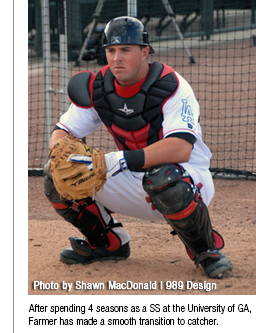
Now the Loons regular catcher, Farmer spent most of his baseball career as a shortstop. As a catcher, he nearly qualifies as a newbie.
 "Our high school coach's dad told me that someday I'd be a catcher because of the size of my hands," Farmer said. "I didn't think much of it then because I was a shortstop and I'd always been a shortstop."
The Atlanta native was a shortstop for four years at the University of Georgia, and was the Bulldogs' starter at that position for 211 career games. He finished with the highest career fielding percentage at shortstop (.968), and set the highest single season mark at .978. He even played shortstop for Team USA.
Still, when the pro scouts watched Farmer, they saw a catcher in the making.
"My senior year I started to catch bullpens to just get comfortable with it," said Farmer. "Then when they saw me throw to second, they (scouts) told me catching was the way to go. But I still figured if I was good enough to play shortstop for Team USA, I could play it for anyone."
The Cincinnati Reds called Farmer after his junior year to tell him that they wanted to draft him as a catcher. But he was still set on playing shortstop, and he was drafted in the 35th round by the New York Yankees instead.
Farmer decided to return for his senior year at Georgia, but when the Dodgers asked to work him out after the Bulldogs' season, there was no mistaking their intentions.
"They told me to not even bring my infielder's glove," Farmer said. "At that point I just wanted the chance to play professionally, and however I needed to get there was fine with me. Whether it was catching, outfield, shortstop … I didn't care."
Loons manager Bill Haselman understands Farmer's catching journey. Haselman was a shortstop in high school and then played mostly in rightfield at UCLA. But the Bruins' pitching coach asked him to switch to catcher.
"I wasn't excited about it at first, but I'm glad I did it," said Haselman, played 13 years in the major leagues as a catcher. "I mean, nothing against Farmer, because he's a great athlete, but it's really tough to make it to the majors as a middle infielder.
"As a catcher, I can see him having a nice, long big league career."
The Dodgers selected Farmer in the 8th round of the 2013 June amateur draft and he's played catcher for 54 of his 57 professional games. He was a designated hitter for the other three.
Given the complex nature of catching and its multi-tasking demands, Farmer has been pushed beyond his normal boundaries as a player. But he's relishing the challenge.
 "You have to have a baseball mentality to play catcher," he said. "You have to know the game because you're so much more involved in every aspect of it. Honestly, it's humbled me as a player.
"(Former big league pitcher) Jamie Moyer, Dillon Moyer's dad, was in town, and he said, when you're starting out as a catcher, you need to learn something new every day. If you're not, then you're falling behind."
While the Loons have set a torrid stolen base pace in April, Farmer has helped them slow down the other team's running games. He threw out 32 percent of would-be base stealers in his first 18 games, an above-average number.
"He exchange and release is very good," said Haselman, referring to the catcher's task of grabbing the ball from his glove and making a quick throw to a base. "It probably comes from playing shortstop, where you have to get rid of the ball quickly."
Pitch-calling is another part of Farmer's learning process. Haselman said he'll occasionally call a pitch in a certain situation but, "It's their game out there."
And Farmer, despite his infielder's background, said he - not by design - has been preparing himself for calling a game all along.
"When I played shortstop I was always calling pitches in my head," said Farmer. "I'd think, 'We should throw him the slider here,' and stuff like that. I could do that because shortstop always came kind of easily to me."
Blocking pitches is yet another line on the list of catcher's duties, and it may be the toughest to learn.
"His blocking needs the most work but that's something tough for any catcher to learn," Haselman said. "He sometimes wants to catch it like a shortstop, but he's coming along. You just have to learn to keep the ball in front of you at all costs."
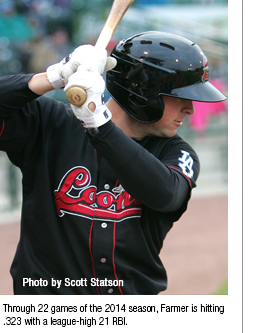
With so many different defensive duties on his plate, it would be easy to excuse Farmer if his offense suffered some. But that hasn't been the case. Through 22 games Farmer was hitting .323 with a league-high 21 RBI. He's also stole four bases to help augment the Loons fast-break approach on the basepaths.
"Well, I'm definitely thinking a lot more about defense now," he said. "I mean, I have pretty good confidence in my hitting. I feel like I can hit and that will take care of itself. But defense is my first priority."
Haselman appreciates Farmer's catcher's mentality.
"The thing about Kyle is that he never talks about his offense," he said. "He's always talking about his defense and what he needs to do better. He really wants to learn and he's working at it every single day."